Presented by Kier-La Janisse, co-editor of the book Truth & Soul: A Robert Downey, Sr. Reader (2025) — Books will be available at the screening
Robert Downey Sr. occupies a singular place in the American cinema; while he emerged from the East coast underground scene of the 1960s, he was always too unserious for the avant garde and too experimental for the mainstream — “a filmmaker out of time,” as my co-editor Clint Enns wrote. His trajectory is like one long Marx Brothers in-joke, subverting tropes, taste and even the tenets of comedy itself. With Greaser’s Palace, Downey followed up the resounding success of Putney Swope (1969) and the tragic absurdity of Pound (1970) — in which a young Robert Downey, Jr. made his first screen appearance — with his own take on the then-burgeoning micro-genre of the messianic acid western.
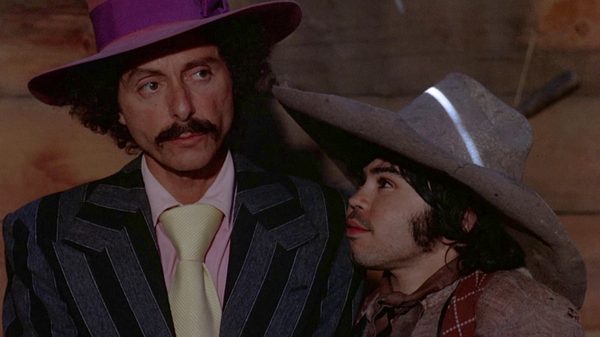
The titular palace is the rickety saloon centerpiece of a windswept desert town ruled by the mercurial and constipated land baron Seaweedhead Greaser. Into this dusty terrain parachutes Jesse (Allan Arbus, M*A*S*H), a zoot-suited Christ figure with amnesia, slinging the slogan “If ya feel, ya heal” and searching for some sort of meaning beyond his own doomed destiny.
The film’s colourful cast of characters include bald-pated Downey staple Lawrence Wolf as a French Padre, Luana Anders (Easy Rider) as Greaser’s daughter and burlesque entertainer, a neighbouring frontier couple played by Hervé Villechaize and Downey regular Stan Gottlieb in drag, cult favourite Don Calfa (Return of the Living Dead) as a platform-heeled talent agent from outer space, a nearby Indigenous tribe whose members include graphic design legend Pablo Ferro (not Indigenous) and “Hey Mickey” songstress Toni Basil (also not Indigenous), a rather literal Holy Ghost, and Greaser’s son Lamy Homo (yes, he actually named a character that), who dies and is resurrected multiple times in the film. Downey’s love of employing repetition to irritating effect is in full force here, with certain lines said over and over until they pass through annoyance and into hilarity.
Anticipating the western parodies of the decade’s latter half, this is one of the most divisive films in Downey’s catalogue and a stupefying spectacle that is best enjoyed on the big screen. — Kier-La Janisse
Kier-La Janisse is a film writer, producer, acquisitions executive for Severin Films and president of Spectacular Optical Media. She is the author of Cockfight: A Fable of Failure (2024), House of Psychotic Women: An Autobiographical Topography of Female Neurosis in Horror and Exploitation Films (2012/2022) among other books.
Robert Downey Sr.
Allan Arbus, Albert Henderson, Michael Sullivan, Luana Anders
USA
1972
English
Book Tickets
Indigenous & Community Access
Indigenous Access Tickets Community Access Tickets Ticket Donation Requests
Credits
Screenwriter
Robert Downey Sr.
Cinematography
Peter Powell
Editor
Bud S. Smith
Original Music
Jack Nitzsche
Also Playing

The Richest Woman in the World
Isabelle Huppert plays cosmetics CEO Marianne in this teasingly ambivalent satire inspired by the Bettancourt Affair, when L'Oreal heir Francoise Bettancourt scandalized France by frittering away her fortune on a notorious celebrity photographer.


Departures
Two lads meet at an airport gate and begin monthly trips to Amsterdam together. Their chemistry is off the charts, but it's Jake who's calls the shots while Benji is the one who's emotionally invested. Comparisons to Pillion and Trainspotting are on mark.