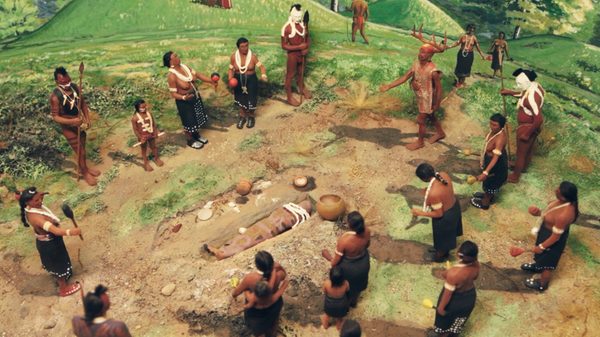
In Aanikoobijigan [Ancestor/Great-Grandparent/Great-Grandchild], Ojibway filmmakers Adam and Zack Khalil turn their attention to the Michigan Anishinaabek Cultural Preservation and Repatriation Alliance (MACPRA), whose members work to bring the human remains and funerary objects of Indigenous Ancestors home from museums, universities, and archives. Through conversations with repatriation specialists, elders, historians, and museum workers, the film follows a process that moves through law, bureaucracy, ceremony, and grief, while confronting the history of colonial violence that placed these remains in institutional collections to begin with.
The documentary’s gaze is guided by a duty of care. The Khalils refuse the detached way museums have allowed the dead to be displayed, and question how Ancestors can be represented without repeating this violence. Past, present, and future begin to fold into one another as preservation becomes inseparable from repair and responsibility. Winner of Sundance’s NEXT Audience Award, Aanikoobijigan is a work of restitution and formal courage, honouring the dignity of the dead and the living communities who remember them.
Content Considerations: Colonial violence, institutional racism, settler-colonialism, residential schools, intense flashing and stroboscopic light
 Audience Award: NEXT, Sundance 2026
Community Partner


Alicia Kathleen Gervais, Elizabeth Bernadette Young, Jim Fletcher, Elvyn Douglas “Doug” Bissonette, Thomas Brings, Matthew Bussler
USA/Denmark
2026
In English and Anishinaabemowin with English subtitles
Nudity; may frighten young children
Open to youth
Indigenous & Community Access
Indigenous Access Tickets Community Access Tickets Ticket Donation Requests
Credits & Director
Executive Producer
Francene Blythe-Lewis, Carrie Lozano, Lois Vossen, Tiffany Sia, Ted Kennedy, Elizabeth Weatherford
Producer
Steve Holmgren, Adam Khalil, Zack Khalil, Grace Remington, Jacque Clark, Franny Alfano
Cinematography
Zack Khalil, Adam Khalil, Jacque Clark, Shaandiin Tome, Sky Hopinka, Bayley Sweitzer, Christopher Yepez, Oresti Tsonopoulos, Samuli Haavisto, Noah Elliott Morrison
ANIM
Driftnote, Atticus Eythan LeMay Stovall, Oliver Franklin Anderson
Editor
Adam Khalil, Zack Khalil
Original Music
Leila Bordreuil, lucky dragons

Adam Khalil
Adam Khalil, a member of the Sault Ste. Marie Tribe of Chippewa Indians, strives to subvert traditional forms of image-making through humour, relativity, and transgression. Khalil is a core contributor to New Red Order and a co-founder of COUSIN Collective whose work has been presented at the Museum of Modern Art, Sundance Film Festival, New York Film Festival, Tate Modern, and Palais de Tokyo, among others. He has received numerous fellowships and grants, including a 2021 Creative Capital Award, 2020 Herb Alpert Award, Sundance Art of Nonfiction, Jerome Artist Fellowship, Cinereach, and the Gates Millennium Scholarship.
Filmography: INAATE/SE/ [it shines a certain way. to a certain place/it flies. it falls./] (2016); EMPTY METAL (2018)


Zack Khalil
Zack Khalil, a member of the Sault Ste. Marie Tribe of Chippewa Indians, is a filmmaker and artist whose use of innovative nonfiction forms centers Indigenous narratives in the present while looking towards the future. Khalil is a core contributor to New Red Order, a public-secret society that explores issues of Indigenous agency, and his work has been shown at the Museum of Modern Art, Sundance Film Festival, New York Film Festival, among others. He is a recipient of fellowships and grants that include a Jerome Hill Artist Fellowship, Sundance Art of Nonfiction, and Gates Millennium Scholarship.
Filmography: INAATE/SE/ [it shines a certain way. to a certain place/it flies. it falls./] (2016); EMPTY METAL (2018)
Spectrum
See more films in this series

Last Movies
What would film history look like reorganized around the last movies various cultural figures watched before they died? Last Movies embraces this simple concept to offer a deliberately skewed and mordantly funny love letter to cinema.

Jaripeo
Efraín Mojica and Rebecca Zweig set their sights on Penjamillo, Michoacán, where the annual Jaripeo — a rodeo of bull riding, drinking, and dust that serves as the town’s public theatre of masculinity — becomes a stage for queer desire.

Aanikoobijigan [Ancestor/Great-Grandparent/Great-Grandchild]
In Aanikoobijigan, Indigenous repatriation specialists work to bring the remains and funerary objects of Ancestors home from institutional collections. This is a film shaped by memory, dignity, and a duty of care.

Crocodile
In Crocodile, a group of young, self-taught filmmakers turn Kaduna's streets, homes, and residents into the raw materials of sci-fi cinema. This Tribeca Viewpoints winner examines filmmaking as a means to overcome a city's constraints.

Let Them Be Seen
Let Them Be Seen is an absurdist portrait of the town of Tapoleng in South Africa’s Eastern Cape, moving through churches, spaza shops, and a Jam Alley re-enactment to document a village reshaping faith and community in post-apartheid life.


Yo (Love Is a Rebellious Bird)
Winner of the Silver Bear for Outstanding Artistic Contribution at this year's Berlinale, Anna Fitch and Banker White’s exuberant documentary combines vérité interviews with a playful mix of puppetry, collage, and insect actors to memorialize a friend.
Image: © Mirabel Pictures
