International Premiere
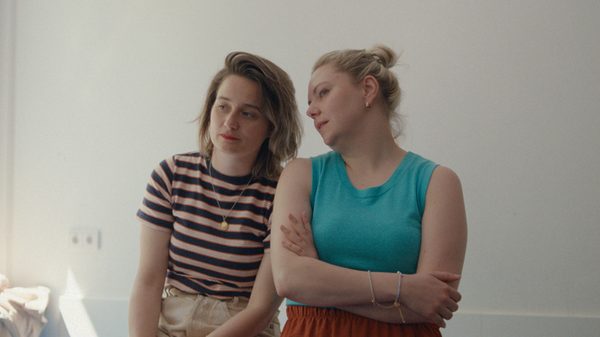
Would your younger self be proud of the life you’re living now? Nico (Marlene-Sophie Haagen) returns to her hometown of Tübingen to lead a workshop with her childhood friend Lori (Ricarda Seifried), who gave up her acting dreams to become a teacher. After prompting their students to write a letter to their future selves, the two friends find themselves questioning the intertwined trajectory of their own lives. The stark contrast between their choices — Nico’s carefree, bohemian life in Berlin and Lori’s safe bourgeois stability — unearths small fissures in their friendship that undermines the versions of themselves they envisioned.
Keenly aware of the subtle dance between fact and fiction people construct to make sense of their lives, co-directors Ella Cieslinski and Nina Wesemann helm their debut feature with a deft assurance. Capturing its characters’ slow awareness of the sudden calcification of inconsequential choices accumulated over the years, Dear Future Self is a sharply tender story about friendship, dreams, and the desire for agency.
 Oct 6 & 7: Filmmaker Q&A
Supported by

Community Partner

Marlene-Sophie Haagen, Ricarda Seifried, Tamer Tahan, Hans Löw, Eva Löbau, Şafak Şengül
Germany
2026
In German with English subtitles
At The Cinematheque
At Fifth Ave
Book Tickets
Indigenous & Community Access
Indigenous Access Tickets Community Access Tickets Ticket Donation Requests
Credits & Director
Producer
Ella Cielinski, Nina Wesemann
Screenwriter
Ella Cielinski, Nina Wesemann
Cinematography
Nina Wesemann
Editor
Florian Seufert
Production Design
Philomena Schmidt

Ella Cieslinski
Ella Cielslinski, born in France, is a Berlin-based writer and director whose work explores questions of identity, longing, and sexuality. She studied screenwriting at the Munich University of Television and Film and graduated in 2018 with a screenplay that received the award for Best Feature Screenplay at the Sehsuchte Film Festival. Her short films Fou de Toi (2015) and Fantasy is a Fleeing Animal (2018) premiered at the Hof International Film Festival. Her debut feature Dear Future Self received the IFFR Pro Award at the Talent Camp Mannheim and premiered at the Munich Film Festival in 2026.


Nina Wesemann
Nina Wesemann, born and raised in Cologne, graduated in 2019 from the University of Television and Film Munich with a degree in documentary filmmaking. Her work is characterized by ongoing close collaborations with other filmmakers and by her versatility across disciplines. She works as a director, cinematographer, and choreographer and was, among other things, responsible for the cinematography of the documentary film Peter Handke (2016). Her feature-length documentary Children premiered at the Berlinale in 2019, and in the winter of 2019-2020 she spent five months aboard the German research icebreaker Polarstern documenting the MOSAiC expedition.
Missing VIFF? Check Out What's Playing at the VIFF Centre

Possible Love
Lee Chang-dong’s first film since Burning (2018) is a sardonic, slow-burning satire about two couples: a documentary filmmaker married to a wealthy businessman, and a working-class family struggling to make ends meet after the husband has been laid off.

The Exorcist
Thirteen-year-old Linda Blair is Regan, the movie star daughter who is possessed by a demon, and whose body becomes a spiritual battleground. It builds slowly, carefully, into a maelstrom of sheer unadulterated horror.

La Bola Negra
A big, old-school historical melodrama gets a thrillingly modern, queer makeover from Spanish duo Javier Calvo and Javier Ambrossi, who artfully juggle three gay protagonists across stories set in 1932, 1937, and 2017. Winner: Best Director, Cannes. Screening on 35mm.

The History of Concrete
After attending a workshop on pitching saccharine Hallmark movies, John Wilson tries to apply all the same best practices to his documentary about concrete. Frequently absurd and endlessly entertaining detours, asides, and digressions ensue.

Once Upon a Time in Harlem
Once Upon a Time in Harlem splices together footage shot by William Greaves in 1972 of a group of Harlem Renaissance luminaries in conversation at Duke Ellington’s townhouse. The film is a living archive of memory, disagreement, style, and Black genius.

An American Werewolf in London
Two American students get into a spot of bother with the wildlife in rural England. Then they introduce the virus to the big city... John Landis's goofy horror comedy is a very good night out. So long as it's not a full moon...