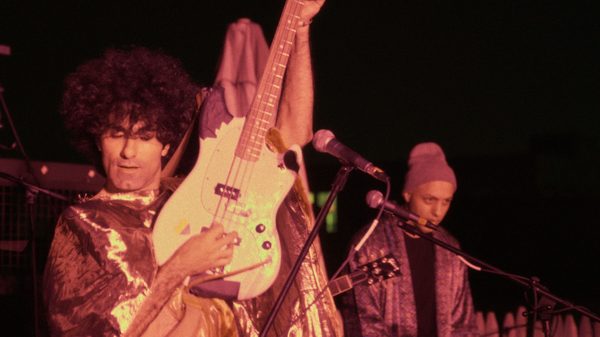
Canadian Premiere
Several years after leaving Iran and resettling in France, filmmaker Mahsa Karampour travels to the USA to reconnect with her younger brother, Siavash — a gregarious indie rock musician who’s encountered fleeting success and considerable tragedy in New York City. As the two wander the metropolis’s streets, then hit America’s highways, memories of their life in Tehran begin to resurface, leading Siavash to find solace in various guises and personas.
Adopting the structure and soulfulness of a classic road movie — combined with the brashness of one of Siavash’s punk anthems — Karampour’s disarmingly intimate documentary investigates the complexity of familial bonds. She reveals the toll of living between worlds, while reminding us that filmmaking can sometimes serve as a form of healing. Guided by curiosity and handled with tremendous care, Into the Jaws of the Ogre is an enthralling example of humanist filmmaking.
Supported by

Community Partner

Siavash Karampour
France
2026
In Persian and English with English subtitles
Book Tickets
Indigenous & Community Access
Indigenous Access Tickets Community Access Tickets Ticket Donation Requests
Credits & Director
Producer
Mathilde Raczymow
Cinematography
Cédric Dupire, Mahsa Karampour
Editor
Saskia Berthod

Mahsa Karampour
Born in Iran, Mahsa Karampour has lived in France since 2003. Alongside her sociology studies at EHESS (Paris), she pursued a cinema program at the Sorbonne Nouvelle University. A graduate in filmmaking from the École documentaire de Lussas, she leads film workshops, works as a camera and sound operator, and contributes to festival programming. In 2024, she performed as an actress in a stage adaptation of Abbas Kiarostami’s Ten directed by Guilda Chahverdi. Into the Jaws of the Ogre (2026) is her first feature film.
Photo by Marie Guichzoua
Spectrum
See more films in this series


Yo (Love Is a Rebellious Bird)
Winner of the Silver Bear for Outstanding Artistic Contribution at this year's Berlinale, Anna Fitch and Banker White’s exuberant documentary combines vérité interviews with a playful mix of puppetry, collage, and insect actors to memorialize a friend.
Image: © Mirabel Pictures

Crocodile
In Crocodile, a group of young, self-taught filmmakers turn Kaduna's streets, homes, and residents into the raw materials of sci-fi cinema. This Tribeca Viewpoints winner examines filmmaking as a means to overcome a city's constraints.


Jaripeo
Efraín Mojica and Rebecca Zweig set their sights on Penjamillo, Michoacán, where the annual Jaripeo — a rodeo of bull riding, drinking, and dust that serves as the town’s public theatre of masculinity — becomes a stage for queer desire.