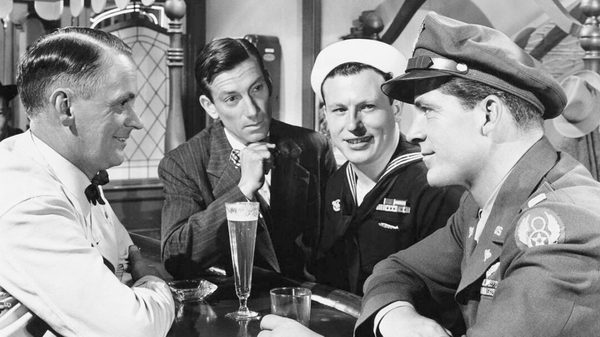
Eighty years ago, Allied troops were coming home after the long, bloody but decisive war against fascism. Moved by an article in Time magazine about the difficulties they faced in readjusting to civilian life, producer Sam Goldwyn commissioned a screenplay from playwright Sherwood Anderson.
Directed by William Wyler, the most acclaimed director of the day (he had experienced combat himself making propaganda films during the war), The Best Years of Our Lives is remarkable for its candor and sensitivity around issues like PTSD, disabilities, isolationism, and the nuclear age. The film went on to win seven Academy Awards, including Best Picture, Director, Actor (Frederic March), and Supporting Actor (Harold Russell)… In fact, it also won an 8th statuette, because Russell, who lost his hands in the war, was presented with a special award “for bringing hope and courage to his fellow veterans.” The cinematography, by Gregg Toland (Citizen Kane) should also have been recognized. It remains one of the crowning achievements of the golden age of the studio era.
Surprisingly modern… lean, direct, honest about issues that Hollywood then studiously avoided […] As long as we have wars and returning veterans, some of them wounded, The Best Years of Our Lives will not be dated.
Roger Ebert
William Wyler’s intimate epic, from 1946 profoundly and sensitively balances the private demons of scarred veterans and the press of public policies that leave their mark on daily life. Wyler, working with a script by Robert E. Sherwood, captures the sense of history being written on the fly, of momentous shifts in mind-sets and expectations. In the movie’s nearly three-hour span, the chrysalis of an old world seems to crack open and a fragile new one begins to emerge; a deep and tender romanticism arises from the exposed vulnerabilities.
Richard Brody, New Yorker
The best American movie about returning soldiers I’ve ever seen—the most moving and the most deeply felt. It bears witness to its times and contemporaries like few other Hollywood features, and Gregg Toland’s deep-focus cinematography is one of the best things he ever did.
Jonathan Rosenbaum, Chicago Reader
William Wyler
Myrna Loy, Fredric March, Dana Andrews, Harold Russell, Teresa Wright, Virginia Mayo
USA
1946
English
7 Academy Awards (Best Picture, Director, Actor, Supporting Actor, Editing, Adapted Screenplay, Score) + Special Award for Harold Russell
Book Tickets
Wednesday November 11
Indigenous & Community Access
Indigenous Access Tickets Community Access Tickets Ticket Donation Requests
Credits
Screenwriter
Robert E. Sherwood
Cinematography
Gregg Toland
Editor
Daniel Mandell
Original Music
Hugo Friedhofer
Also Playing

The Pervert's Guide to Cinema
The Pervert's Guide to Cinema takes the viewer on an exhilarating ride through some of the greatest movies ever made (Hitchcock, Lynch, Tarkovsky et al). Serving as guide is Slavoj Zizek, the superstar Slovenian philosopher and psychoanalyst.

NAZA
NAZA is a codeword euphemistically used by Israeli intelligence to indicate the number of civilians it expects will be killed in an airstrike. This chilling documentary exposes the policy and process of state-sanctioned mass killings.

Atonement
A former Marine suffering from PTSD seeks a meeting with the Iraqi family to which he did great wrong ten years earlier in the Gulf War. Atonement navigates challenging, politically-charged psychological territory with diligence and sensitivity.

The Pervert's Guide to Ideology
Slavoj Zizek re-teams with director Sophie Fiennes for another wildly entertaining romp through the crossroads of cinema and philosophy. From The Sound of Music to Titanic, Jaws to The Dark Knight, Zizek offers new ways to understanding Hollywood.