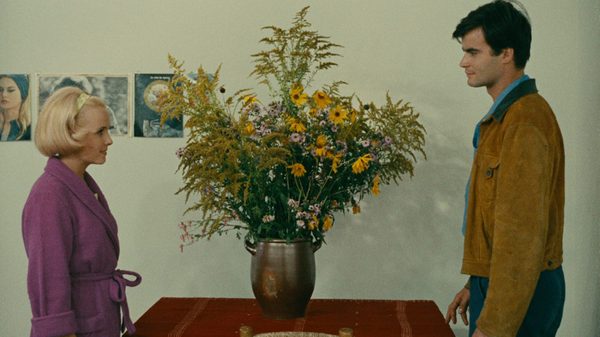
Often described as the most beautiful horror film, Le Bonheur uses the stark juxtaposition of stunning floral French summertime with emotional devastation brewing just under the surface. Following a seemingly idyllic family, it lulls you into a false sense of security as it slowly unravels an insidious betrayal between two lovers. The brutal heartbreak of its final act seems at once inevitable and shocking, marking Le Bonheur as a revelation of cinematic feminist commentary.
 Oct 5: Intro by Sophy Romvari
Le Bonheur’s masterful visual poetry and slow build toward emotional revelation were guiding forces behind the development of Blue Heron. Varda puts an immense trust in the audience to follow a deceptively simple scenario as she elegantly applies cracks to the facade. I followed a similar architecture with my film, building a subtle escalation of familial dysfunction set against the background of a beautiful natural landscape. I was also inspired by Varda’s use of a distinct colour palette and striking imagery, especially in relation to the depiction of the innocence of young children within a family unit. Le Bonheur emphasizes atmosphere and subtle emotional shifts between characters rather than conventional plot and narrative momentum. This gave me confidence for the cadence of how Blue Heron unfolds.
Sophy Romvari, Leading Lights Guest Programmer
Supported by

Media Partner

Agnès Varda
Jean-Claude Drouot, Claire Drouot, Marie-France Boyer, Sandrine Drouot, Olivier Drouot, Paul Vecchiali
France
1965
In French with English subtitles
Book Tickets
Indigenous & Community Access
Indigenous Access Tickets Community Access Tickets Ticket Donation Requests
Credits
Producer
Mag Bodard
Screenwriter
Agnès Varda
Cinematography
Jean Rabier, Claude Beausoleil
Editor
Janine Verneau
Original Music
Wolfgang Amadeus Mozart
Missing VIFF? Check Out What's Playing at the VIFF Centre

NAZA
NAZA is a codeword euphemistically used by Israeli intelligence to indicate the number of civilians it expects will be killed in an airstrike. This chilling documentary exposes the policy and process of state-sanctioned mass killings.

Once Upon a Time in Harlem
Once Upon a Time in Harlem splices together footage shot by William Greaves in 1972 of a group of Harlem Renaissance luminaries in conversation at Duke Ellington’s townhouse. The film is a living archive of memory, disagreement, style, and Black genius.

Knife: The Attempted Murder of Salman Rushdie
Alex Gibney's doc relates the near-lethal attack on Salman Rushdie in 2022, the writer's painful rehab and recovery, and his reflections on life before, during and after the publication of The Satanic Verses.

Possible Love
Lee Chang-dong’s first film since Burning (2018) is a sardonic, slow-burning satire about two couples: a documentary filmmaker married to a wealthy businessman, and a working-class family struggling to make ends meet after the husband has been laid off.

You Had to Be There
In a strange quirk of fate, the legendary Toronto '72 production of the musical comedy Jesus hit Godspell launched a constellation of comedy stars, all unknown at the time but now known to us as Martin Short, Eugene Levy, Dave Thomas, Victor Garber, et al

House of Hope
"House of Hope" is the name of a Waldorf elementary school near Jerusalem in the occupied West Bank, founded by Manar and her husband Milad. This documentary follows their efforts to go about their lives before, during, and after the events of October 7.