NAZA is a codeword euphemistically used by Israeli intelligence to indicate the number of civilians it expects will be killed in an airstrike. These days, the murder of women and children is no accident. As interviews with some two dozen serving military operatives make clear, when Israeli missiles are sent into Gaza all potential casualties have been factored in. One Hamas agent is worth 15 NAZA, or more.
Produced by Jonathan Glazer and James Wilson (The Zone of Interest), this investigative documentary by Yuval Abraham and Rachel Szor (No Other Land) is both restrained and chilling, a sombre, modest but unforgettable and deeply upsetting film that demonstrates how modern technology is not only facilitating mass killings, it’s benumbed the conscience of the killers and maybe the rest of us too.
Didn’t get a ticket? Just want to see it again? NAZA will be returning to the VIFF Centre starting Oct 12.
Content Considerations: The film includes a brief but graphic sequence depicting devastation from a collapsed building
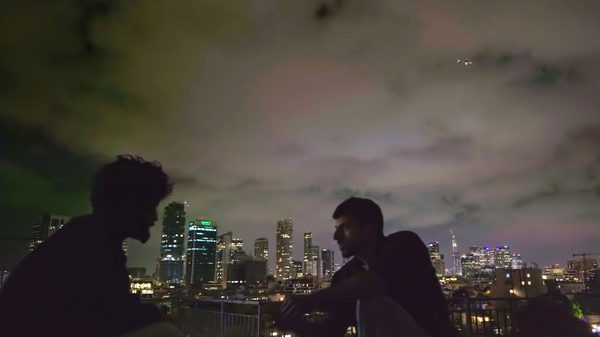
We made this film out of a sense of obligation to use our position as Israeli filmmakers and journalists to examine the systems behind the mass killing of Palestinian civilians for which our country is responsible. While filming members of Israel’s military on rooftops at night in Tel Aviv over the past three years, we found ourselves asking the very questions that were asked by our grandparents’ generation and throughout the 20th century: how does one group of people allow the total dehumanisation of another? What do the inner workings of such a system look like?
Many of the revelations in the film were published almost immediately as we learned of them, in the months following the October 7th attacks, by The Guardian (one of NAZA’s producers), in collaboration with reporting partners +972 Magazine and Local Call. The film lets us explore something deeper than we could in our investigative journalism alone: not only the words being said but also those that are not said, the silence. It is up to all of us to break that silence.
Yuval Abraham and Rachel Szor
 Special Jury Prize, Venice 2026
UK
2026
In Hebrew and English with English subtitles
Book Tickets
Indigenous & Community Access
Indigenous Access Tickets Community Access Tickets Ticket Donation Requests
Credits & Director
Executive Producer
Jonathan Glazer, Joseph Schull, Harriet Gugenheim, Wendy vanden Heuvel
Producer
Harry Davies, Lindsay Poulton, James Wilson
Cinematography
Anonymous, Rachel Szor
Editor
Yuval Abraham, Rachel Szor, Harry Davies

Yuval Abraham, Rachel Szor
Filmography: No Other Land (2024)
Missing VIFF? Check Out What's Playing at the VIFF Centre

American Doctor
One of the most powerful documentaries of the year, this puts us smack in the open wound that is Gaza, filtered through the eyes of three American surgeons (of Palestinian, Jewish and Zoroastrian backgrounds) compelled to do their utmost to alleviate harm.

The History of Concrete
After attending a workshop on pitching saccharine Hallmark movies, John Wilson tries to apply all the same best practices to his documentary about concrete. Frequently absurd and endlessly entertaining detours, asides, and digressions ensue.

La Bola Negra
A big, old-school historical melodrama gets a thrillingly modern, queer makeover from Spanish duo Javier Calvo and Javier Ambrossi, who artfully juggle three gay protagonists across stories set in 1932, 1937, and 2017. Winner: Best Director, Cannes. Screening on 35mm.

A. Rimbaud
Patrick Wang (The Bread Factory) presents the life of French poet Arthur Rimbaud in this staggeringly adventurous and deeply considered movie, a three-hour, one-man show quite unlike anything we have seen before. "Poetic, audacious and singular."


The 39 Steps
In our new film studies series, FRAMEWORK, film scholar Michael van den Bos explores the work of Alfred Hitchcock, across four monochrome masterworks. This week: The 39 Steps (1935), a witty and fast-moving spy thriller from Hitchcock's English period.