Canadian Premiere
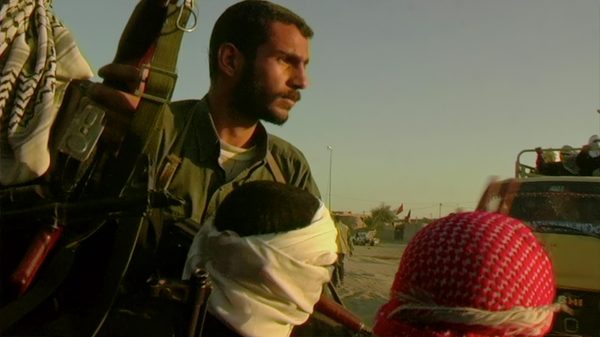
The new millennium begins in troubled waters. In The Story of Documentary Film – The 2000s, Mark Cousins enters a decade in which reality seems to arrive already altered by the camera, starting in Japan before turning to 9/11 — the most filmed event in history — and the wars fought in its name. Footage becomes evidence, warning, spectacle, and wound. Documentary is no longer only recording the century; it’s caught inside the way the century sees itself.
Cousins doesn’t move through this history like a neutral guide. His idiosyncratic voiceover gathers films, images, arguments, and intuitions into a map shaped by his own politics, speculations, and preoccupations. With works such as The Cove and Grizzly Man, these chapters follow nonfiction cinema as it faces fear, violence, obsession, governmental collapse, and images that helped justify a never-ending war. Part of Cousins’ 16-hour global history of the documentary form, this chapter asks what nonfiction cinema could still reveal as the promise of modernity begins to unravel on camera.
Content Considerations: Archival footage from documentaries of war, self-harm, environmental distress, and whale hunting from The Cove (2009), mentions of gun violence and gender discrimination
Showcase Series Supported by

UK/USA
2026
English
Book Tickets
Indigenous & Community Access
Indigenous Access Tickets Community Access Tickets Ticket Donation Requests
Credits & Director
Executive Producer
Joslyn Barnes, Frank Lehmann, Clara Glynn, Diana Bustamante
Producer
John Archer
Cinematography
Mark Cousins
Editor
Timo Langer
Original Music
Donna McKevitt

Mark Cousins
Mark is a Scottish-Irish filmmaker and writer whose works focus on politics, visual culture, history, cities, childhood, and recovery. At the start of his career, Cousins made TV documentaries on childhood, neo-Nazis, and Mikhael Gorbachev. In the mid-90s, he partnered with the Edinburgh International Film Festival to host film screenings in Sarajevo for its besieged citizens. His first book was Imagining Reality: The Faber Book of Documentary (2006). He has walked across Los Angeles, Belfast, Moscow, Beijing, London, Paris, Berlin, Dakar, and Mexico City. He drove from Edinburgh to Mumbai and loves night swimming.
Filmography: The Story of Film: An Odyssey (2011); Women Make Film: A New Road Movie Through Cinema (2019); The Story of Film: A New Generation (2021)
Photo by Jenny Leask
Missing VIFF? Check Out What's Playing at the VIFF Centre

American Doctor
One of the most powerful documentaries of the year, this puts us smack in the open wound that is Gaza, filtered through the eyes of three American surgeons (of Palestinian, Jewish and Zoroastrian backgrounds) compelled to do their utmost to alleviate harm.

The History of Concrete
After attending a workshop on pitching saccharine Hallmark movies, John Wilson tries to apply all the same best practices to his documentary about concrete. Frequently absurd and endlessly entertaining detours, asides, and digressions ensue.

La Bola Negra
A big, old-school historical melodrama gets a thrillingly modern, queer makeover from Spanish duo Javier Calvo and Javier Ambrossi, who artfully juggle three gay protagonists across stories set in 1932, 1937, and 2017. Winner: Best Director, Cannes. Screening on 35mm.

A. Rimbaud
Patrick Wang (The Bread Factory) presents the life of French poet Arthur Rimbaud in this staggeringly adventurous and deeply considered movie, a three-hour, one-man show quite unlike anything we have seen before. "Poetic, audacious and singular."


The 39 Steps
In our new film studies series, FRAMEWORK, film scholar Michael van den Bos explores the work of Alfred Hitchcock, across four monochrome masterworks. This week: The 39 Steps (1935), a witty and fast-moving spy thriller from Hitchcock's English period.