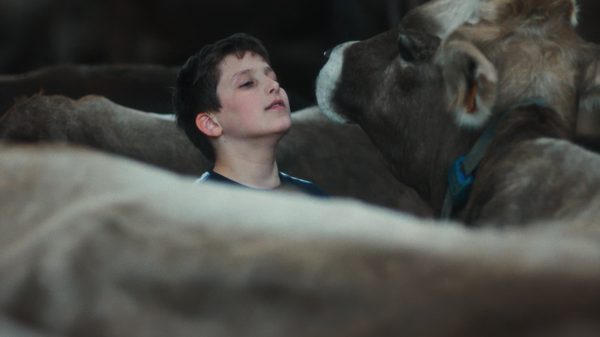
When Maxence Voiseux first films Gabin Jourdel, he is eight years old — the youngest child in a farming family in rural northern France. Over the next decade, we witness Gabin’s growth and the animals, schoolwork, chores, and imagined futures that define his youth. His father wants him to inherit the butcher shop, but Gabin is more concerned with living animals — and in helping save his mother’s cattle farm from financial ruin.
Voiseux’s feature documentary debut has the patience to let its conflict unfold without wringing it for drama. Her access is extraordinary precisely for its ordinariness: time moves without declaring itself, and the camera joins its subjects for family arguments, quiet work, and the small changes that mark the passage of adolescence. Premiering in Cannes Directors’ Fortnight, Gabin turns coming of age into a question of inheritance, following a child’s tenderness toward animals as it becomes a young man’s fight for a life of his own choosing.
Supported by

Media Partner

Community Partner


Gabin Jourdel, Patricia Jourdel, Dominique Jourdel, Lilou Duflos-Lamotte, Catherine Ranson
France/Germany/
Switzerland
2026
In French with English subtitles
Book Tickets
Indigenous & Community Access
Indigenous Access Tickets Community Access Tickets Ticket Donation Requests
Credits & Director
Producer
Cécile Lestrade, Elise Hug
Screenwriter
Maxence Voiseux
Cinematography
François Chambe, Martin Roux
Editor
Pascale Hannoyer, Natali Barrey
Original Music
Nicolas Rabaeus

Maxence Voiseux
Maxence Voiseux was born in the Ardennes in 1988. He studied science before switching paths to join the Documentary Cinema programme at Paris VII University, where he trained in directing and editing. Gabin (2026) is his first feature film.
Photo by Alter Ego Production
Missing VIFF? Check Out What's Playing at the VIFF Centre

American Doctor
One of the most powerful documentaries of the year, this puts us smack in the open wound that is Gaza, filtered through the eyes of three American surgeons (of Palestinian, Jewish and Zoroastrian backgrounds) compelled to do their utmost to alleviate harm.

The History of Concrete
After attending a workshop on pitching saccharine Hallmark movies, John Wilson tries to apply all the same best practices to his documentary about concrete. Frequently absurd and endlessly entertaining detours, asides, and digressions ensue.

La Bola Negra
A big, old-school historical melodrama gets a thrillingly modern, queer makeover from Spanish duo Javier Calvo and Javier Ambrossi, who artfully juggle three gay protagonists across stories set in 1932, 1937, and 2017. Winner: Best Director, Cannes. Screening on 35mm.

A. Rimbaud
Patrick Wang (The Bread Factory) presents the life of French poet Arthur Rimbaud in this staggeringly adventurous and deeply considered movie, a three-hour, one-man show quite unlike anything we have seen before. "Poetic, audacious and singular."


The 39 Steps
In our new film studies series, FRAMEWORK, film scholar Michael van den Bos explores the work of Alfred Hitchcock, across four monochrome masterworks. This week: The 39 Steps (1935), a witty and fast-moving spy thriller from Hitchcock's English period.