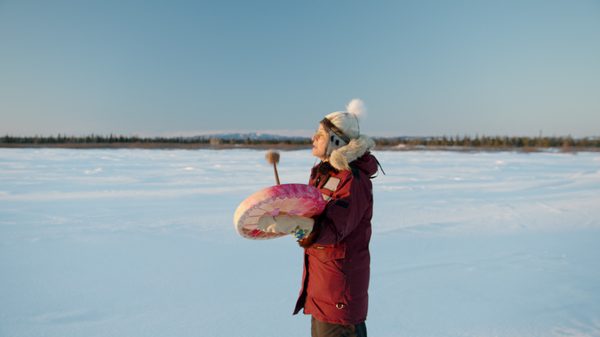
For the Innu people, Nitassinan is far more than their ancestral territory; it is a living entity that nourishes their language, guides their traditions, and forms an intrinsic part of their collective identity. Moving across past, present, and future, Nitassinan offers an intimate testimony to an unbreakable bond with the land that sustains the Innu, even in their dreams. Attentive to the rhythms of the territory and the voices of those who know it intimately, the film unfolds as a quiet act of listening.
Celebrated Innu poet Joséphine Bacon reunites with acclaimed filmmaker Kim O’Bomsawin, who previously directed Call Me Human (Je m’appelle humain, VIFF 2020) about Bacon, for this lyrical portrait of a people’s enduring relationship with their homeland. Capturing expansive landscapes with a patient, observational eye, Nitassinan becomes both an expression of love and gratitude and a meditation on what it means to inherit, remember, and carry a culture forward.
Nitassinan will be preceded by the short film, Haboolm Ksinaalgat (Soul Catcher) by Amanda Strong and Pamela Post. In Haboolm Ksinaalgat (Soul Catcher), teenager Lu’oo’ya is visited by an ancient shaman, who opens a portal using an ooligan-greased mirror. Together, the two traverse space and time to confront and heal the colonial history still haunting their ancestors.
 Oct 8 & 9: Filmmaker Q&A for short film Haboolm Ksinaalgat (Soul Catcher)
Supported by

Media Partner

Community Partner


Canada
2026
In French and Innu with English subtitles
Open to youth
Indigenous & Community Access
Indigenous Access Tickets Community Access Tickets Ticket Donation Requests
Credits & Director
Producer
Kim O’Bomsawin, Elodie Pollet
Screenwriter
Joséphine Bacon, Carlos Ferrand, Émilie Porry
Cinematography
Hugo Gendron, Maxime Pilon-Lalande
Editor
Annie Leclair, Mélanie O’Bomsawin
Original Music
Wyler Wolf

Kim O'Bomsawin
Kim O’Bomsawin is an Abenaki filmmaker from Odanak. She directed and scripted the feature length documentary Je m’appelle humain (2020), a sensitive portrait of Innu poet Joséphine Bacon, and directed the four-part documentary series Telling Our Story, selected at TIFF in 2023. In 2024, she won the Best Canadian Documentary Award at VIFF and the Magnus Isacsson Award at the Montreal International Documentary Festival for her film Ninan Auassat: Nous, les enfants. Since 2020, Kim has been a producer and the president of Nikan Productions (formerly Terre Innue).
Photo by Christinne Muschi


Joséphine Bacon
Joséphine Bacon, born 1947, is an Innu poet from Pessamit. A filmmaker and lyricist, she is considered a leading author in Quebec and has worked as a translator and interpreter with elders. She has written several poetry collections, including Nipishapui nete mushuat/Un thé dans la toundra (2013), which was a finalist for the Governor General’s Literary Award and the Grand Prix du livre de Montréal, and Uiesh/Somewhere (2018), which earned her the 2019 Booksellers’ Prize. In 2023, she received the prestigious Molson Prize from the Canada Council for the Arts for her invaluable contribution to literature.
Filmography: Tshishe Mishtikuashisht – Le petit grand Européen: Johan Beetz (1997)
Insights
See more films in this series

Birds of War
Told through phone videos, voice notes, texts, and news footage, Birds of War documents the love story of Lebanese journalist Janay Boulos and Syrian activist Abd Alkader Habak as their connection deepens and their communications grow in urgency.

A Place of Absence
A Place of Absence follows the Caravan of Mothers of Missing Migrants along migration routes through Mexico and toward the United States, while tracing the disappearance that shaped the filmmaker’s own family history.

A Distant Call
In the South Sulawesi province of Indonesia, Eka, one of the few remaining bissu — spiritual leaders who embody the aspects of all genders — struggles to reconcile their identity with community expectations and their own devout Muslim faith.

Whispers in May
Whispers in May follows Qihuo and her friends in China’s Liangshan Mountains as childhood gives way to womanhood. It blends close observation and scenes of the girls' search with animated fragments of Yi oral myth to create a hypnotic coming-of-age film.


Who Moves America
Who Moves America follows UPS teamsters through their 2023 contract negotiations. Director Yael Bridge turns meetings, rallies, votes, and everyday conversations into a clear-eyed portrait of solidarity and building power.


Revolutionaries Never Die
Revolutionaries Never Die is Mohanad Yaqubi’s reply to Jocelyne Saab, who passed away before the two could collaborate. Yaqubi's film serves as equal parts tribute, conversation, and partnership with the revolutionary past.

Once Upon a Time in Harlem
Once Upon a Time in Harlem splices together footage shot by William Greaves in 1972 of a group of Harlem Renaissance luminaries in conversation at Duke Ellington’s townhouse. The film is a living archive of memory, disagreement, style, and Black genius.

Nuisance Bear
Winner of the highly coveted Sundance Grand Jury Prize for Documentary, Nuisance Bear follows a polar bear through Churchill, Manitoba, where the town profits from bears as spectacle while treating their arrival as a problem.

Closure
In Closure, Michał Marczak follows Daniel, a father searching the Vistula River after his teenage son disappears from Warsaw’s Gdański Bridge. Resisting true-crime spectacle, this is a film questions whether hope can sometimes keep you trapped.

Kikuyu Land
Kikuyu Land follows Mr. Mungai’s struggle to reclaim family land taken during the colonial era. Through personal stories and archival research, the film explores the enduring impact of land dispossession in Kenya.

Gabin
Filmed over 10 years, Gabin follows Gabin Jourdel from age 8 to 18 and the animals, schoolwork, chores, and imagined futures that define his youth. As he grows, his adolescence becomes a question of inheritance and choosing one’s own future.