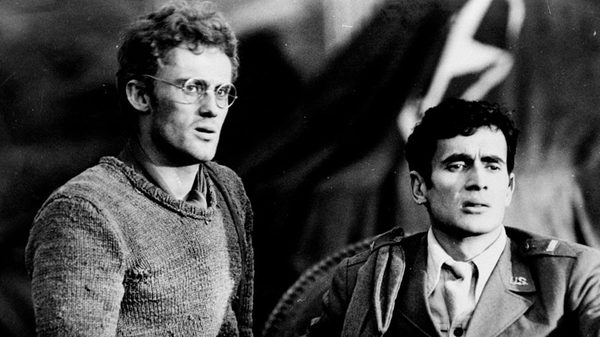
A Ukranian-born Pole, Tadeusz Borowski was sent to Auschwitz in 1943 and later transferred to Dachau. After the war, and internment in a displaced persons camp, he wrote the autobiographical, surrealistic short story collection, This Way for the Gas, Ladies and Gentlemen, which became the chief inspiration for Wajda’s film, with Daniel Olbrychski playing Tadeusz. The camp has been liberated by the Americans, but the young writer is far from free — until he meets a young Jewish woman, Nina (Stanisława Celińska) who persuades him they must escape together…
In reality, Borowski committed suicide in 1951, age 28.
Screenings of Andrzej Wajda’s films in North America in 2026 are part of the ‘Wajda 100 Tour – North America’ project, organized by DI Factory with the financial support of the Polish Film Institute. Special thanks to Jessica Rosner.
It is so beautifully composed, so elegiacal, it compels attention and will be likely to stay in the memory for a very long time.
Vincent Canby, New York Times
Wajda’s strange, turbulent, bracing film sees him returning to his old stomping ground of World War II, but the style is far more expressionist and fragmentary, the political analysis more complex, than in his famous trilogy. Wajda uses his darting camera to extract endless cruel ironies from the grim setting.
Geoff Brown, Time Out
Andrzej Wajda
Daniel Olbrychski, Stanisława Celińska, Alexander Bardini
Poland
1970
In Polish with English subtitles
Indigenous & Community Access
Indigenous Access Tickets Community Access Tickets Ticket Donation Requests
Credits
Screenwriter
Andrzej Wajda, Andrzej Brzozowski
Cinematography
Zygmunt Samosiuk
Editor
Halina Prugar-Ketling
Original Music
Zygmunt Konieczny
Andrzej Wajda 100
Toted as the father of Polish cinema, discover the works of Andrzej Wajda — arthouse classics done up in sparkling 4K restorations in honour of Wajda’s centennial year celebration.


A Generation
Wajda's first film is set in Warsaw, 1942 and concerns a young man much like himself, living in squalor and doing his best to disrupt the German Occupation, eventually falling in with a Communist-leaning Resistance cell.


Innocent Sorcerers
The closest Wajda got to a new wave film (and in fact it was shot before Godard's Breathless) this is an edgy romance about a womanizing jazz musician who hooks up with a liberated young woman over the course of an evening. Scripted by Jerzy Skolimowski.

The Ashes
Wajda's massive historical epic chronicles Poland's tragic involvement in the Napoleonic Wars, 1797-1812. The Poles fight alongside Napoleon in the hope of gaining independence, but it's a deal with the devil...


Landscape After The Battle
Based on the autobiographical short story collection This Way for the Gas, Ladies and Gentlemen, Wajda's film shows a concentration camp survivor, Tadeusz in a displaced persons camp in the immediate aftermath of WWII.

The Birch Wood
A different side of Wajda: this is a romantic, sensual, bittersweet work. Stanislaw (Olgierd Łukaszewicz) is an ebullient artist who comes to visit his forester brother, Boleslaw (Daniel Olbrychski), a gloomy widower.

The Wedding
This densely allegorical satire is based on a 1901 play by Stanislaw Wyspianski, which was in turn based on a real wedding between a member of the affluent intelligentsia and a farmgirl. The drunken village revelries spiral through the night....

Man of Marble
One of the towering achievements in Wajda's career, Man of Marble is a Polish, proletarian Citizen Kane, with a 70s student filmmaker unearthing the fate of a working class hero, a bricklayer celebrated in Stalinist propaganda films in the 1950s.

Rough Treatment (aka Without Anesthesia)
Scripted by Agnieszka Holland, Rough Treatment is a key film of "the cinema of moral anxiety" in Poland in the 1970s, a Kafkaesque account of the dissolution a TV correspondent's marriage, his career, and indeed, everything else by which he sets store.

Man of Iron
Forged in the furnace of the Gdansk shipyard strikes that propelled Poland's first union independent of the communist party, Solidarity, and its leader Lech Welesa, to the forefront of history, Man of Iron is an extraordinary follow up to Man of Marble.

The Maids of Wilko
This wistful tale finds jaded WWI veteran Wiktor (Daniel Olbrychski) returning to the summer estate he used to visit before the war, and to the Wilko farm, where five sisters remember him fondly. Academy Award Nominee: Best Foreign Language Film

Danton
A morally and politically complex drama set during the French Revolution's Reign of Terror, Wajda's fiery film clearly reflected his experiences of what was going on in Poland at the time, for all that was made in exile.

Korczak
With an admirably unsentimental script by Agnieszka Holland, and black-and-white cinematography by Robby Müller (Paris, Texas), Wajda relates the true story of the renowned doctor and teacher who ran a Jewish orphanage in the midst of the Holocaust.

Katyn
Returning to the subject of WWII once more, Wajda made perhaps his most personal film, broaching the once taboo topic of the massacre of some 22,000 Polish prisoners of war by the Red Army in the Kaytn forest, 1940. Among the victims, Wajda's father.