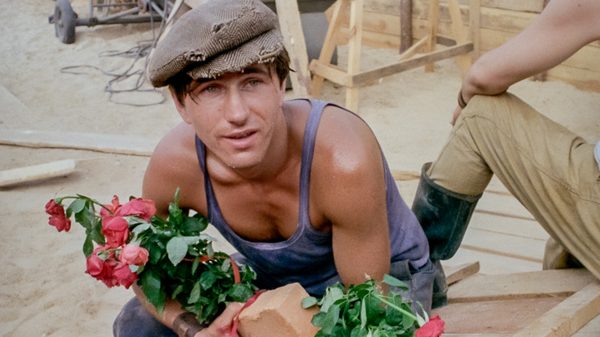
Agnieszka (Krystyna Janda) is a determined young filmmaker who decides to look into the fate of a working class hero, a bricklayer by the name of Birkut (Jerzy Radziwilowicz) who was celebrated in goverment propaganda films in the 1950s, but who subsequently disappeared from view. Piecing together discarded and suppressed archival footage and interviews with friends and colleagues, she assembles a portrait of an honest man caught in a system failing to live up to its promises.
Wajda’s film can be described as a proletarian Citizen Kane, and it’s every bit as skeptical of the communist system as Welles’ movie is towards capitalism. Indeed, the then Polish Prime Minister took strong exception to the film and the Culture Minister who approved it was compelled to resign. The film was initially only granted a limited release in Poland but it became a word-of-mouth hit and played a part in inspiring the Solidarity protest movement that would challenge communist authoritarianism a few years later (chronicled in Wajda’s 1981, Palme d’Or winning sequel, Man of Iron.)
Screenings of Andrzej Wajda’s films in North America in 2026 are part of the ‘Wajda 100 Tour – North America’ project, organized by DI Factory with the financial support of the Polish Film Institute. Special thanks to Jessica Rosner.
A dizzying work that deconstructs the mythology of a proletariat hero of the 1950s, while concurrently exploring the rise of the world-famous solidarity movement in the late 70s and reflexively examining his cinematic form. Using a filmmaker as a lens into the past, the film is structurally and formally breathtaking, imbuing an epic canvas with urgent political vim.
Ben Nicholson, Sight & Sound
It’s a long, riveting exploration, bitterly comic, utterly convincing, as exciting as a thriller and one of the best records we have of its time. Man of Marble revived Wajda’s reputation and gave him new purpose, and it inspired the careers of Krzysztof Zanussi, Agnieszka Holland, Krzysztof Kieślowski and Ryszard Bugajski as film-makers.
Philip French, The Guardian
Andrzej Wajda’s Man of Marble is the Polish Citizen Kane—with all that implies about the film’s structure, scope, ambition, impact, influence, and choice of protagonist… A dynamic, brilliantly structured, and continually engrossing work with the immediacy of a battlefield dispatch.
J. Hoberman, Village Voice
Andrzej Wajda
Jerzy Radziwiłowicz, Krystyna Janda, Michal Tarkowsk
Poland
1977
In Polish with English subtitles
Indigenous & Community Access
Indigenous Access Tickets Community Access Tickets Ticket Donation Requests
Credits
Screenwriter
Aleksander Ścibor-Rylski
Cinematography
Edward Kłosiński
Editor
Halina Prugar
Original Music
Andrzej Korzyński
Andrzej Wajda 100
Toted as the father of Polish cinema, discover the works of Andrzej Wajda — arthouse classics done up in sparkling 4K restorations in honour of Wajda’s centennial year celebration.


A Generation
Wajda's first film is set in Warsaw, 1942 and concerns a young man much like himself, living in squalor and doing his best to disrupt the German Occupation, eventually falling in with a Communist-leaning Resistance cell.


Innocent Sorcerers
The closest Wajda got to a new wave film (and in fact it was shot before Godard's Breathless) this is an edgy romance about a womanizing jazz musician who hooks up with a liberated young woman over the course of an evening. Scripted by Jerzy Skolimowski.

The Ashes
Wajda's massive historical epic chronicles Poland's tragic involvement in the Napoleonic Wars, 1797-1812. The Poles fight alongside Napoleon in the hope of gaining independence, but it's a deal with the devil...


Landscape After The Battle
Based on the autobiographical short story collection This Way for the Gas, Ladies and Gentlemen, Wajda's film shows a concentration camp survivor, Tadeusz in a displaced persons camp in the immediate aftermath of WWII.

The Birch Wood
A different side of Wajda: this is a romantic, sensual, bittersweet work. Stanislaw (Olgierd Łukaszewicz) is an ebullient artist who comes to visit his forester brother, Boleslaw (Daniel Olbrychski), a gloomy widower.

The Wedding
This densely allegorical satire is based on a 1901 play by Stanislaw Wyspianski, which was in turn based on a real wedding between a member of the affluent intelligentsia and a farmgirl. The drunken village revelries spiral through the night....

Man of Marble
One of the towering achievements in Wajda's career, Man of Marble is a Polish, proletarian Citizen Kane, with a 70s student filmmaker unearthing the fate of a working class hero, a bricklayer celebrated in Stalinist propaganda films in the 1950s.

Rough Treatment (aka Without Anesthesia)
Scripted by Agnieszka Holland, Rough Treatment is a key film of "the cinema of moral anxiety" in Poland in the 1970s, a Kafkaesque account of the dissolution a TV correspondent's marriage, his career, and indeed, everything else by which he sets store.

Man of Iron
Forged in the furnace of the Gdansk shipyard strikes that propelled Poland's first union independent of the communist party, Solidarity, and its leader Lech Welesa, to the forefront of history, Man of Iron is an extraordinary follow up to Man of Marble.

The Maids of Wilko
This wistful tale finds jaded WWI veteran Wiktor (Daniel Olbrychski) returning to the summer estate he used to visit before the war, and to the Wilko farm, where five sisters remember him fondly. Academy Award Nominee: Best Foreign Language Film

Danton
A morally and politically complex drama set during the French Revolution's Reign of Terror, Wajda's fiery film clearly reflected his experiences of what was going on in Poland at the time, for all that was made in exile.

Korczak
With an admirably unsentimental script by Agnieszka Holland, and black-and-white cinematography by Robby Müller (Paris, Texas), Wajda relates the true story of the renowned doctor and teacher who ran a Jewish orphanage in the midst of the Holocaust.

Katyn
Returning to the subject of WWII once more, Wajda made perhaps his most personal film, broaching the once taboo topic of the massacre of some 22,000 Polish prisoners of war by the Red Army in the Kaytn forest, 1940. Among the victims, Wajda's father.