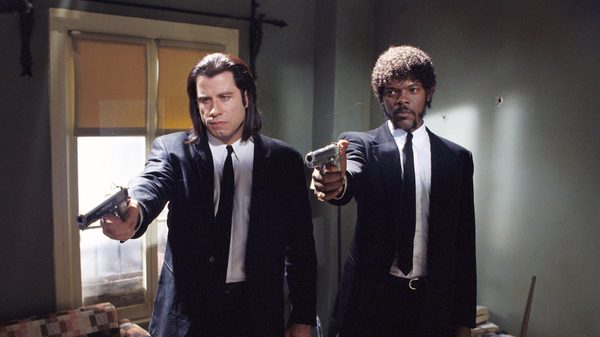
As decades must, the 1990s had a beginning, a middle and an end. But in the spirit of Quentin Tarantino we’re going to launch our big summer series 90s, Baby smack in the middle, with 1994’s Pulp Fiction, the most original, exciting and influential movie of its era. On 35mm.
A pop post-modernist and voracious cultural magpie, Tarantino came out of nowhere (well, Video Archives), who was hailed as a new god of filmmaking overnight. With Reservoir Dogs (1992), Pulp Fiction and his screenplays for True Romance (1993) and Natural Born Killers (94) he electrified 90s film culture, changing the way movies sounded, the way they flowed, and how they connected with audiences. His emergence coincided with the advent of the world wide web, and Tarantino constructed his genre hybrids from a wide array of international influences — French new wave, American noir and 70s exploitation pictures, Hong Kong action cinema — rewriting the rule book as he did so.
Pulp Fiction scrambles the chronology of three interlocking narratives, as if in homage to Godard’s observation that a story should have a beginning, a middle and an end “but not necessarily in that order”. Revitalizing the careers of several flagging A-list stars at a stroke (John Travolta, Bruce Willis and Harvey Keitel), Tarantino unleashed a torrent of black comic verbal riffs and repartee. If the tone is ironic, the characters are iconic, and the momentum never flags throughout its 154-minute running time. Backed by Miramax Films, the indie company that dominated movie talk in the 90s (even as it was bought up by Disney), Pulp Fiction won the Palme d’Or and broke the $100 million barrier at the North American box office, ushering in the era of the “mini-major”, through which the studios co-opted many of the best and brightest of the independent sector.
Content Considerations: Graphic violence
It is everything you have heard, and many things you haven’t. Audacious, outrageous, indulgent, extreme. Mischievously brutal. Giddily visceral. Wildly enthusiastic. More fun than a barrel of monkeys. Mad, bad and dangerous to know.
Rob Salem, Toronto Star
Media Partner

Quentin Tarantino
John Travolta, Samuel L Jackson, Uma Thurman, Harvey Keitel, Bruce Willis
USA
1994
English
Palme d’Or, Cannes; Academy Award, Best Original Screenplay
Book Tickets
Indigenous & Community Access
Indigenous Access Tickets Community Access Tickets Ticket Donation Requests
Credits
Screenwriter
Quentin Tarantino
Cinematography
Andrzej Sekula
Editor
Sally Menke
Production Design
David Wasco
Art Director
Charles Collum
90s, Baby!
Ten years. 11 weeks. 90 films from the 1990s. This summer, 90’s Baby! takes a deep dive into a defining decade of cinema.

The Blair Witch Project
The rushes of a student-made documentary investigating the legend of the Blair Witch in Burkittsville, Maryland, a quest that led the three filmmakers deep into the Appallachian woods. Easy to get lost in there...


Lessons of Darkness
Werner Herzog's unforgettable documentary reveals the unfolding disaster of the Kuwaitian oil fields in flames in 1991 as a sweeping inferno of mesmerizing power.


Beau Travail
Inspired by Herman Melville's Billy Budd, Claire Denis' transfixing Beau Travail is set in East Africa. Sgt Galoup (Denis Lavant) reflects on his time in the French Foreign Legion, and the impact of the handsome Sentain (Gregoire Colin).

Three Kings
George Clooney headlines David O Russell's bold, brazen attempt to get to grips with the immediate aftermath of Operation Desert Storm, as 4 US soldiers try to liberate a missing shipment of gold amidst the chaos and carnage.


But I'm a Cheerleader
Megan (Natasha Lyonne) is the perfect All-American Girl, or so she thinks. That is until she’s shipped off to conversion therapy. This pitch black comedy is wrapped in a saccharine bow, featuring the icon herself, RuPaul, as a conversion counsellor.

Magnolia
This deeply personal 1999 California opus is ripe for rediscovery. Mapping the emotional traumas of half-a-dozen major characters as they crisscross the San Fernando Valley in search of either recognition or reconciliation, it's PTA's riskiest gamble.

Election
Tracy Flick (Reece Witherspoon) is running for Student President, but Mr. McAllister (Matthew Broderick) has other ideas... This remarkably sour millennial comedy from Alexander Payne (The Holdovers; Sideways; The Descendents) hits twice as hard today.

Ghost Dog: Way of the Samurai
Ghost Dog (Forest Whitaker) is an assassin, but he's also an existential loner who adheres to his personal code. Despite the thriller trappings, this is really a lampoon of that genre, and a melancholy reverie for the cultural melting pot we call home.

The Straight Story
David Lynch goes a different direction in this linear Midwestern about a septuagenarian (Richard Farnsworth) who drives nearly 400km on a lawnmower to visit his ailing brother (Harry Dean Stanton).

90s Surprise Film
The 90s movie we have all been missing... Join us for a celebratory wake for this year's 90s, Baby series! What you will be seeing is top secret (no, not Top Secret!, that was 1984) but it will be at least 26 years old and it will be new to this series.

The Wind Will Carry Us
Kiarostami's dry comic masterpiece follows a Tehrani film team's thwarted attempts to document a traditional Kurdish funeral... Trouble being, there's no one to bury, and, worse, virtually no cell service...

Fight Club
1999 was a very good year for movies, but nothing captured millennial angst quite so vividly as David Fincher's bruising black comedy about what it means to be a man today. This modern classic does everything short of rattling your seat to get a reaction.